
UK Work Visa Full Guide 2026: Complete Requirements, Eligibility, Salary Rules, Costs & Application Process
UK Work Visa Full Guide 2026
The United Kingdom remains one of the world’s most attractive destinations for skilled professionals seeking international career opportunities. Whether you are an IT expert, engineer, nurse, doctor, accountant, teacher, or construction professional, the UK job market continues to offer thousands of vacancies supported by licensed employers willing to sponsor overseas workers. However, the immigration system has evolved significantly in 2026, bringing updated salary thresholds, revised eligibility criteria, and stricter compliance rules that applicants need to understand before applying.
Unlike previous years, employers and applicants must now pay close attention not only to annual salary levels but also to updated sponsorship and payroll compliance requirements. The Skilled Worker Visa continues to be the primary work route for international professionals, replacing the old Tier 2 visa system. To qualify, applicants generally need a genuine job offer from a UK-licensed sponsor, meet the English language requirement, and satisfy the relevant salary threshold or occupation-specific “going rate,” whichever is higher. Recent government updates have also increased the standard salary threshold for many applicants to £41,700 per year, although certain occupations and eligible applicants may qualify under reduced thresholds.
The good news is that obtaining a UK work visa is still achievable if you understand the requirements and prepare correctly. This guide explains everything you need to know, from eligibility and documentation to salary rules, costs, processing times, and practical tips for improving your chances of success.
Understanding the UK Work Visa System
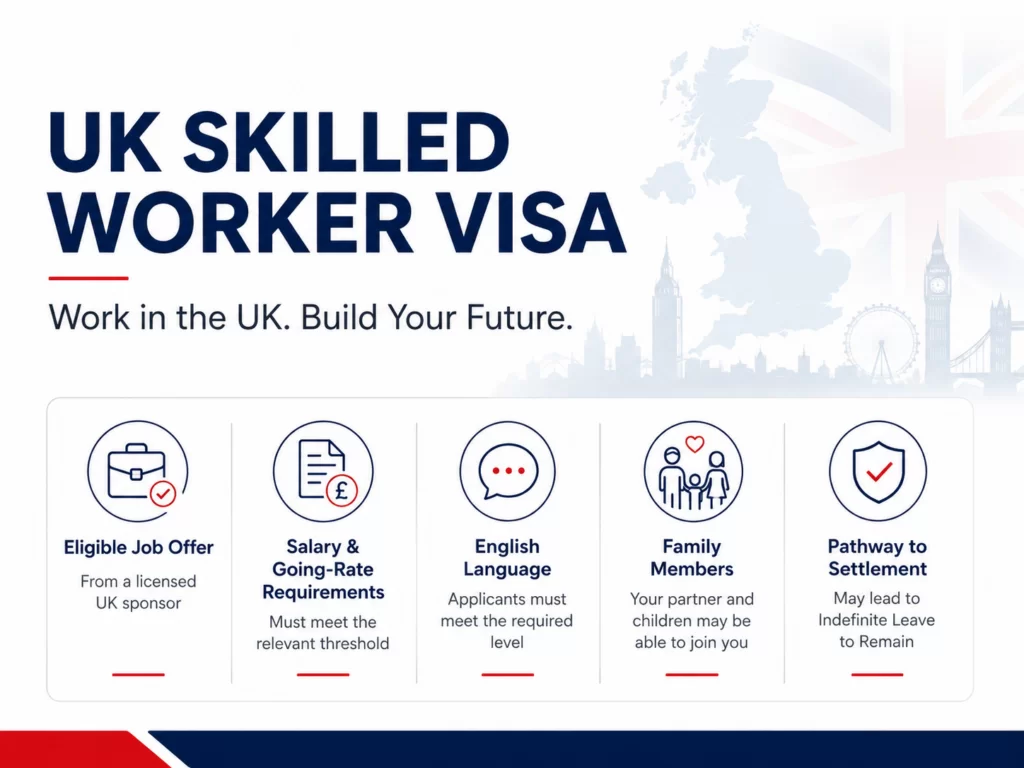
The UK operates a points-based immigration system designed to attract skilled workers who can contribute to the country’s economy. Instead of simply applying for a visa independently, most applicants must first secure employment with a business that holds a valid Home Office sponsor licence. Once hired, the employer issues a Certificate of Sponsorship (CoS), which serves as the foundation of the visa application.
Several work visa categories exist, but the Skilled Worker Visa remains the most popular because it offers a pathway to long-term residence and eventually permanent settlement for eligible applicants. Other routes include the Health and Care Worker Visa for medical professionals and several Temporary Worker routes for short-term employment.
One of the biggest developments in 2026 is the emphasis on salary compliance throughout employment rather than only at the point of application. Employers are expected to maintain compliant payroll practices, making sponsorship responsibilities more stringent. These changes aim to ensure overseas workers receive fair wages while reducing misuse of the sponsorship system.
Types of UK Work Visas
The UK offers multiple work visa options depending on your profession and employment situation.
The Skilled Worker Visa is suitable for professionals with a qualifying job offer from an approved employer. It covers hundreds of occupations, including software developers, engineers, teachers, architects, accountants, laboratory technicians, and many others.
The Health and Care Worker Visa is specifically designed for qualified healthcare professionals, including doctors, nurses, paramedics, care workers, and senior care workers. Applicants under this route often benefit from reduced visa fees and faster processing.
Temporary Worker visas are available for seasonal employment, charity work, creative professionals, religious workers, and government-authorized exchange programs. These visas generally do not provide a direct pathway to permanent settlement but can be useful for gaining UK work experience.
Each visa category has different requirements, making it important to identify the correct route before beginning the application.
UK Skilled Worker Visa Eligibility
Eligibility begins with obtaining a genuine job offer from an employer that holds a valid UK sponsor licence. Without sponsorship, most overseas workers cannot apply for a Skilled Worker Visa.
Applicants must also receive a valid Certificate of Sponsorship containing detailed information about their role, salary, employer, and occupation code. The offered position must appear on the list of eligible occupations published by the UK government.
English language proficiency is another essential requirement. Most applicants demonstrate this by passing an approved English language test or presenting an accepted academic qualification taught in English.
Applicants must also prove they have enough financial resources to support themselves unless their sponsoring employer agrees to cover maintenance costs.
Meeting these requirements does not automatically guarantee approval, but it significantly strengthens the application.
Salary Requirements in 2026
Salary rules have become one of the most important parts of the UK Skilled Worker Visa process.
For many applicants, the standard salary threshold is £41,700 per year or the official “going rate” for the occupation, whichever is higher. Every occupation has its own minimum salary based on government guidance, meaning some professions require salaries significantly above the general threshold.
Certain applicants may qualify under lower salary thresholds, including:
| Applicant Category | Possible Lower Salary Requirement |
|---|---|
| Immigration Salary List occupations | Lower qualifying threshold may apply |
| New entrants | Reduced salary threshold available |
| Relevant PhD holders | Discounted salary rules |
| Health and Care workers | Separate salary scales |
Applicants should always verify their occupation code because salary requirements differ considerably across industries. Accepting a salary below the required threshold may result in visa refusal.
Required Documents
Preparing complete documentation is one of the easiest ways to avoid unnecessary delays.
Typical documents include:
- Valid passport
- Certificate of Sponsorship number
- English language evidence
- Bank statements (if required)
- Tuberculosis test certificate (for certain countries)
- Criminal record certificate (where applicable)
- Educational qualifications
- Employment contract or offer letter
Additional documents may be requested depending on your nationality, occupation, or personal circumstances.
Step-by-Step Application Process
The UK work visa application follows a structured process.
- Find employment with a licensed UK sponsor.
- Receive your Certificate of Sponsorship.
- Gather all required supporting documents.
- Complete the online visa application.
- Pay the visa fee and Immigration Health Surcharge (if applicable).
- Book your biometric appointment.
- Submit fingerprints and photographs.
- Wait for the Home Office decision.
- Receive your eVisa approval if successful.
Many applicants receive decisions within approximately three weeks when applying from outside the UK, although processing times can vary depending on application volumes and additional verification requirements.
Visa Fees and Processing Time
Visa costs vary depending on visa duration and occupation category.
| Expense | Approximate Cost |
|---|---|
| Skilled Worker Visa Fee | Varies by visa length |
| Immigration Health Surcharge | Payable annually |
| English Test | Depends on provider |
| TB Test | Country dependent |
| Biometrics | Usually included with application process |
Applicants should also budget for document translation, courier services, and travel expenses if required.
Conclusion
The UK Work Visa 2026 continues to provide outstanding opportunities for qualified professionals seeking international careers. Although salary thresholds and sponsorship rules have become stricter, thousands of overseas applicants continue to receive approval every year by carefully following the official requirements.
Success largely depends on securing employment with a licensed sponsor, understanding the latest salary rules, preparing accurate documentation, and submitting a complete application. Staying updated with official Home Office guidance before applying is equally important because immigration policies may change throughout the year.
With proper preparation, realistic expectations, and the right employer, working and building a future in the United Kingdom remains an achievable goal.
Frequently Asked Questions
1. What is the minimum salary for a UK Skilled Worker Visa in 2026?
For many applicants, the standard salary threshold is £41,700 per year or the occupation’s going rate, whichever is higher.
2. Can I apply without a job offer?
No. Most Skilled Worker Visa applicants must first obtain a job offer from a licensed UK employer.
3. How long does the application take?
Most overseas applications are processed within about three weeks, although complex cases may take longer.
4. Can my family accompany me?
Yes. Eligible dependants, including your spouse or partner and children, may apply to accompany you if they meet the relevant immigration requirements.
5. Can a UK Skilled Worker Visa lead to permanent residence?
Yes. Many Skilled Worker Visa holders become eligible to apply for Indefinite Leave to Remain (ILR) after meeting the required residence and eligibility conditions.