

L-1 Visa Full Guide 2026: Requirements, Process, Fees, L-1A, L-1B and Green Card Options
The L-1 visa remains one of the most important U.S. work visa options for international companies in 2026. It allows qualifying multinational businesses to transfer certain employees from an overseas office to a related office in the United States. Unlike visas designed primarily for new hires, the L-1 category is built around an existing business relationship between the foreign and U.S. entities and an existing employment relationship with the employee. That makes it particularly useful for companies expanding into America, transferring senior managers, moving executives, or bringing employees with specialized company knowledge to a U.S. operation. The U.S. Department of State classifies the L category as an intracompany transferee visa, while USCIS handles the underlying immigration petition process.
If you are searching for an L-1 visa full guide 2026, you probably want answers to practical questions. Who qualifies? What is the difference between L-1A and L-1B? How much does the process cost? Can your spouse and children come with you? Can an L-1 visa lead to a Green Card? These questions matter because the L-1 route is not simply about having a job offer from a U.S. company. The company structure, your previous employment, your role abroad, your proposed U.S. position, and the relationship between the businesses can all play a major role. Think of the L-1 as a bridge connecting two qualifying parts of the same international business family rather than a general employment visa open to any employer.
What Is the L-1 Visa?
The L-1 visa is a temporary U.S. work visa for qualifying intracompany transferees. In simple terms, an employee who has worked for a qualifying organization outside the United States may be transferred to a related company, branch, subsidiary, affiliate, or qualifying office in the United States. The visa is divided into two main classifications: L-1A for managers and executives and L-1B for employees with specialized knowledge. The distinction is extremely important because the eligibility standards, maximum periods of stay, and possible long-term immigration strategies can differ. The U.S. government lists the L category under petition-based temporary worker visas, meaning the immigration process generally begins with the employer’s petition rather than with the employee independently applying for the visa without employer sponsorship.
One useful feature of the L category is that it recognizes the international nature of modern companies. A global technology company may need to move a manager from its office in Pakistan, the UAE, the United Kingdom, India, or another country to supervise a U.S. team. A manufacturing company may need an employee who understands a proprietary production system developed within the organization. The L-1 framework can potentially address these situations when all legal requirements are met. Still, simply working for a famous multinational company does not automatically qualify someone. Immigration authorities look at the actual corporate relationship, employment history, duties, and supporting evidence. A strong L-1 case is usually one where the business story and documentary evidence fit together like pieces of a puzzle.
L-1A vs. L-1B: Understanding the Main Difference
L-1A Visa for Managers and Executives
The L-1A visa is designed for qualifying employees who will work in the United States in an executive or managerial capacity. This does not necessarily mean that every person with the word “manager” in a job title qualifies. Immigration analysis focuses heavily on the real duties and level of authority involved. A qualifying manager or executive generally needs to perform duties that fit the legal standards for managerial or executive capacity rather than spending most of the working day performing ordinary operational tasks. For example, managing a major department, supervising professional employees, exercising significant authority, or directing important organizational functions may be relevant depending on the structure of the company and the facts of the individual case.
The L-1A category is especially attractive to international businesses because it can support transfers involving senior leadership. Imagine an overseas company opening or expanding a U.S. office and needing an experienced executive who already understands the company’s systems, customers, strategy, and internal structure. Hiring someone new in the United States might not provide the same continuity. The L-1A category can potentially allow that experienced person to move into the U.S. operation. The maximum stay rules for L-1A are generally more generous than for L-1B, and qualifying L-1A managers and executives may later explore an employment-based immigrant route such as the multinational manager or executive category, subject to meeting separate requirements.
L-1B Visa for Specialized Knowledge Employees
The L-1B visa is for qualifying employees with specialized knowledge connected to the company’s products, services, research, equipment, techniques, management, processes, or other relevant aspects of the organization’s business. Specialized knowledge should not be confused with ordinary professional skill. An employee may be highly educated and talented but still need to demonstrate why their knowledge fits the specialized requirements of the L-1B category. The focus can include advanced familiarity with the company’s own systems, procedures, products, or processes and the significance of that knowledge to the U.S. operation.
Consider a company that has spent years developing an internal software platform used across its global operations. An employee abroad may possess deep practical knowledge of how that particular system works, how it is customized, and how it connects to the company’s internal processes. If the U.S. operation needs that knowledge, an L-1B transfer may potentially be considered, depending on the complete facts and evidence. The key lesson is that L-1B is not simply a visa for skilled workers. The employer must present a convincing explanation of the employee’s specialized knowledge and why the proposed U.S. role qualifies under the applicable standards. Weak descriptions filled with generic statements can create problems because immigration officers need to understand the employee’s actual value and responsibilities.
Basic L-1 Visa Eligibility Requirements in 2026
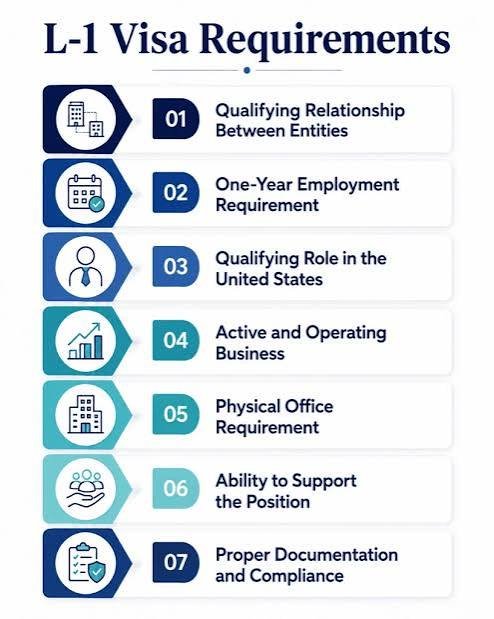
The One-Year Employment Requirement
One of the most important L-1 requirements is the employee’s qualifying employment abroad. In general, the employee must have worked for a qualifying organization outside the United States for at least one continuous year within the relevant three-year period before the transfer or qualifying application event. This requirement is one of the central pillars of the L-1 category. If that employment history cannot be established properly, the entire case may face serious difficulty even when the employee has excellent qualifications or the U.S. company genuinely wants to hire them.
The employer should be prepared to document the overseas employment with credible evidence. Depending on the circumstances, this can include employment records, payroll documentation, tax or social insurance records, contracts, organizational charts, letters explaining duties, and other relevant business records. The exact evidence will vary by country and case. What matters is consistency. Dates should align across documents, job duties should make sense when compared with organizational records, and the employee’s claimed role should be supported by objective evidence where possible. An L-1 application is much stronger when it tells a clear business story that is also backed by paperwork.
The Qualifying Relationship Between the Companies
The foreign company and the U.S. company must also have a qualifying relationship. Depending on the facts, this may involve a parent company, subsidiary, affiliate, or branch relationship or another qualifying organizational connection recognized under the L classification rules. This corporate relationship is not just a technical detail. It is one of the foundations of the entire petition. USCIS may examine ownership, control, corporate records, company structures, shareholding, and related documentation to determine whether the entities qualify.
This is why business documents are so important. Companies should not assume that simply sharing a brand name or having informal business cooperation is enough. The petition may need to show how the entities are legally connected and how ownership or control operates. Corporate registration documents, ownership records, share certificates, annual reports, organizational documents, and charts can become important evidence. For complex multinational groups, the corporate structure may resemble a large family tree, and the petition needs to show exactly where the foreign entity and U.S. entity fit within that tree.
Requirements for the U.S. Position
The proposed U.S. job must also fit the requested L-1 classification. For an L-1A, the company must establish that the employee will work in a qualifying executive or managerial capacity. For an L-1B, the proposed work must involve qualifying specialized knowledge. This is where job descriptions matter, but a generic job description is rarely enough by itself. The employer should explain what the employee will actually do, how much authority they will have, who they will supervise if relevant, what decisions they can make, and how their duties fit within the broader U.S. organization.
A common mistake is relying too heavily on job titles. A title such as “Director,” “Manager,” or “Executive” may sound impressive, but immigration authorities can look beyond the label. A small business may have a person called a manager who personally performs most routine services, while another employee in a larger organization may qualify as a functional manager despite supervising few or no direct employees. The details matter. The structure of the company, staffing levels, delegation of routine work, reporting relationships, and actual duties can all affect the analysis. In other words, the label on the office door is less important than what happens behind that door each day.
The L-1 Visa Application Process Step by Step
Step 1: The Employer Prepares the Petition
For many individual L-1 cases, the process begins when the U.S. employer prepares and files the appropriate petition with USCIS. The employee does not simply visit a U.S. embassy and request an L-1 visa based on a verbal job offer. The petition process generally requires the employer to explain the qualifying relationship between the businesses, demonstrate the employee’s qualifying employment abroad, and show that the proposed U.S. position fits the requested classification. USCIS materials for the L classification include specific filing instructions and fee requirements for the L petition process.
Preparation is often the stage where the quality of the case is determined. A well-organized petition anticipates obvious questions and answers them with evidence. Why do the companies qualify? When and where did the employee work abroad? What did the employee actually do? What will the employee do in the United States? Why does the U.S. organization need this particular transfer? A petition should make these answers understandable to someone who has never visited the company or met the employee. The goal is clarity, not simply producing a huge stack of documents.
Step 2: USCIS Reviews the Petition
After filing, USCIS reviews the petition and may approve it, deny it, or request additional evidence. The exact processing experience can vary by case and filing circumstances. Companies should avoid assuming that approval is guaranteed simply because they have successfully transferred employees before. Each petition must be supported according to its own facts. A growing company may face questions different from those faced by a large, established multinational corporation, while a new U.S. office may require particularly careful evidence regarding business plans and operations.
Premium processing may be available for eligible L-1 petitions. USCIS instructions identify L-1 classifications, including Blanket L-1 cases, among classifications eligible for premium processing, with a 15-day processing period when the service is available under the applicable rules. The premium-processing fee was adjusted effective March 1, 2026, with the federal rule listing $2,965 for qualifying L petitions. Premium processing speeds USCIS action under the applicable service framework; it does not guarantee approval.
Step 3: Apply for the Visa at a U.S. Embassy or Consulate
Once the required petition stage has been completed, an applicant outside the United States may need to complete the consular visa process. The Department of State’s current temporary worker visa guidance lists important documents such as a valid passport, the DS-160 confirmation page, fee payment information where required, a qualifying photo, and the petition receipt information or approval documentation. Applicants connected to a Blanket L petition may need to bring Form I-129S. Additional documents can also be requested by the embassy or consulate handling the case.
The consular interview is another reason to understand your own case thoroughly. You should be able to explain your employer, your work abroad, your proposed U.S. role, and the purpose of the transfer accurately and consistently. Do not memorize a dramatic speech. A simple, truthful explanation is usually better. If your paperwork says you manage a major function but you cannot explain what that function is, what authority you have, or why the transfer is necessary, the inconsistency can raise questions.
L-1 Visa Fees in 2026
L-1 costs can involve several separate fees, and the final total depends on the type of filing and the circumstances of the employer and applicant. USCIS instructions published for the L petition list an I-129L filing fee of $805. The same instructions state that an initial approval request for an L nonimmigrant or certain other covered cases can require a $500 Fraud Prevention and Detection Fee. Certain large employers meeting the statutory workforce threshold can also be subject to an additional $4,500 fee under Public Law 114-113. These fees are not necessarily applicable to every case, so applicants and employers should check the current instructions for their exact filing situation.
At the consular stage, the Department of State currently lists the nonimmigrant visa application processing fee for petition-based L visas as $205. The Department of State also notes a $500 fraud prevention fee for principal applicants included in an L blanket petition and explains that certain applicants may face the additional statutory fee where applicable. Depending on nationality, an approved applicant may also have a visa issuance or reciprocity fee. Because government fees can change, always confirm the amount before submitting payment rather than relying on an old blog post or social media video.
| Possible L-1 Cost | Current 2026 Amount or Status |
|---|---|
| USCIS Form I-129L filing fee | $805 |
| Fraud Prevention and Detection Fee in covered cases | $500 |
| Additional statutory fee for certain large employers | $4,500 |
| Department of State L visa application fee | $205 |
| L-1 premium processing fee from March 1, 2026 | $2,965 |
| Reciprocity or issuance fee | Depends on nationality/country |
How Long Can You Stay in the United States on an L-1 Visa?
The maximum period of stay depends largely on whether you hold L-1A or L-1B status and on the details of your qualifying employment and extensions. Generally, L-1A managers and executives can have a longer maximum stay than L-1B specialized knowledge employees. This difference matters when planning an international assignment. A company should not treat the initial approval as the end of immigration planning. If the employee may need to remain in the United States for several years, the employer should understand the relevant extension rules and potential long-term options early.
Long-term planning is especially important because an L-1 visa is still a temporary nonimmigrant classification. An employee’s future may involve returning abroad, extending qualifying status where permitted, moving to another immigration category, or pursuing permanent residence through a separate process. No single strategy fits everyone. A manager who appears to have a strong L-1A profile may later examine a multinational manager or executive immigrant route, while an L-1B employee’s options may depend on qualifications, employer needs, labor certification issues, or other immigration categories. The best approach is to treat immigration planning as a roadmap rather than a last-minute emergency.
L-2 Visa for Spouses and Children
Qualifying family members may be eligible for L-2 status. Generally, this category can include the principal L-1 holder’s spouse and qualifying unmarried children under the applicable age limit. The family application process and documentation requirements should be reviewed carefully because each person’s circumstances and travel documents matter. Family members should also understand that visa issuance and admission are separate stages. Having a visa in a passport does not remove the need to satisfy applicable inspection requirements when seeking entry to the United States.
For many families, the ability to move together is one of the practical advantages of an intracompany transfer. An international assignment can be difficult enough without separating a manager or employee from their immediate family for years. Still, families should plan carefully for issues beyond immigration paperwork, including housing, education, health insurance, banking, taxes, and employment rules. Immigration status is only one part of moving internationally. A successful transfer often requires the company and family to prepare for the entire transition rather than focusing only on the visa interview.
Can an L-1 Visa Lead to a Green Card?
The L-1 visa can be part of a longer-term path toward permanent residence, but an L-1 visa itself is not a Green Card. A separate immigrant petition and eligibility analysis are required for permanent residence. L-1A managers and executives are often discussed alongside employment-based options for multinational managers or executives because some cases may have overlapping factual elements. That does not mean every L-1A holder automatically qualifies for an immigrant petition. The immigrant category has its own requirements, evidence standards, and procedural steps.
L-1B holders may also explore employment-based immigration, but the route may differ depending on education, experience, job requirements, employer plans, and the applicable immigration category. In some situations, an employer may consider a labor certification-based process; in others, a different employment-based category may be relevant. The Department of State advises employment-based immigrant visa applicants to follow current visa bulletin and fee information because immigrant processing involves separate rules and potential availability considerations.
New Office L-1 Visa: Opening a U.S. Business Office
What Is a New Office L-1 Case?
A new office L-1 case can be relevant when a qualifying international company wants to establish operations in the United States and transfer a qualifying employee to help develop the new U.S. office. This can be an exciting route for international business expansion, but it is not a shortcut for obtaining a U.S. visa. The company must still satisfy the underlying L-1 requirements and provide persuasive evidence concerning the business relationship, the employee’s previous qualifying employment, and the proposed U.S. operations.
New office cases often require careful planning because the U.S. company may not yet have the same level of staff, revenue, physical operations, or business history as an established office. The petition may therefore need to explain how the business will grow and how the transferred employee’s role will fit into that development. Business plans, financial projections, premises information, hiring plans, organizational structures, and evidence of available resources can become particularly important. A new office application should feel like a realistic business plan supported by facts, not a vague promise that a successful company might eventually appear.
Blanket L-1 Petitions
Some larger multinational organizations may use a Blanket L-1 petition when they meet the relevant requirements. This framework can simplify the transfer process for qualifying employees of eligible organizations, although it does not mean every employee automatically receives L-1 status. The Department of State specifically states that applicants included in an L blanket petition must bring Form I-129S to the visa interview and may be subject to specific blanket-petition fee requirements.
For employees, the practical lesson is simple: do not assume that your company’s size alone determines whether you can use a blanket petition. Your employer must qualify for the blanket framework, and your individual position and employment history must also fit the relevant requirements. Large corporations may have dedicated immigration teams that handle this process, but the employee should still review submitted information carefully. Your dates, job titles, work history, and proposed role should be accurate because inconsistencies can create unnecessary delays.
Common Reasons an L-1 Visa Case May Face Problems
Many L-1 difficulties begin with weak or inconsistent evidence. A company may claim that an employee is a manager but provide documents showing that the employee mainly performs routine tasks with little managerial authority. Another case may claim specialized knowledge while describing skills that appear common in the industry. Corporate documents may fail to clearly establish the relationship between the foreign and U.S. entities. Employment dates may conflict across letters, payroll records, and forms. These problems can make an otherwise legitimate business transfer much harder to understand.
Preparation should focus on substance rather than decoration. A polished cover letter cannot fix evidence that contradicts the central claim. Companies should review the case as if they were an independent officer encountering the business for the first time. Does the corporate structure make sense? Does the employee’s career history support the requested category? Are the proposed duties realistic? Does the U.S. organization have enough operational structure to support the claimed managerial position? Are specialized knowledge claims specific enough to distinguish the employee’s knowledge from ordinary industry experience? Honest, detailed answers to these questions can help identify weaknesses before filing.
L-1 Visa Interview Tips for 2026
The best interview preparation is understanding the truth of your case. Know the basic facts about your company, including what it does, where you worked, how long you worked there, and what you did in your overseas position. Understand your proposed U.S. role and be able to explain the transfer in straightforward language. You should not exaggerate your title, salary, authority, or specialized knowledge. Immigration records should tell one consistent story, and your interview answers should fit that story.
Bring documents requested by the embassy or consulate and follow local instructions because procedures can vary. The Department of State’s guidance for temporary worker visas identifies core documents such as the passport, DS-160 confirmation, fee receipt where required, photo, and petition information, while additional documentation may be requested. L blanket applicants have the additional Form I-129S requirement described in the State Department guidance.
Important L-1 Visa Facts to Remember
The L-1 category is often misunderstood because people focus on the word “transfer” and overlook the evidence behind it. The visa is not a general job visa for anyone offered a position by a U.S. company. It is based on a qualifying intracompany relationship and qualifying employment circumstances. The employee usually needs the required history with the foreign organization, while the employer must establish the required relationship between the businesses and the qualifying nature of the U.S. position.
Another important point is that approval by USCIS and visa issuance by a U.S. consulate are separate parts of the broader immigration process for applicants who need a visa abroad. Government fees can also come from different agencies, which is why a complete cost calculation should distinguish USCIS petition fees, premium-processing fees if selected, Department of State application fees, and any case-specific statutory or reciprocity charges. Current Department of State information lists $205 for petition-based L visa applications, while current USCIS L petition instructions list the $805 filing fee and identify possible additional fees in covered cases.
Conclusion
The L-1 visa in 2026 can be an excellent option for qualifying international companies and employees, but success depends on meeting specific requirements and presenting a well-documented case. The two main categories serve different purposes: L-1A for qualifying managers and executives and L-1B for qualifying specialized knowledge employees. The employee’s overseas work history, the relationship between the foreign and U.S. entities, and the nature of the proposed U.S. role are all central to eligibility. The process may involve a USCIS petition, a consular application for applicants outside the United States, and several possible government fees.
Before applying, verify the latest official instructions because immigration rules, forms, processing practices, and fees can change. As of the current 2026 information cited above, the Department of State lists a $205 L visa application processing fee, USCIS instructions list an $805 I-129L filing fee, and the premium-processing fee for qualifying L petitions increased to $2,965 effective March 1, 2026. A carefully prepared case can make the process easier to understand, while poor documentation can create unnecessary obstacles. If your situation involves a complex corporate structure, a new U.S. office, unusual job duties, previous immigration issues, or a future Green Card strategy, obtaining advice from a qualified U.S. immigration professional may be especially valuable.
Frequently Asked Questions About the L-1 Visa
1. What is the L-1 visa?
The L-1 visa is a U.S. temporary work visa category for qualifying intracompany transferees. It allows certain employees of an international organization to transfer from a qualifying foreign office to a related office in the United States. The two principal categories are L-1A for qualifying managers and executives and L-1B for qualifying employees with specialized knowledge. Eligibility depends on the employee’s work history, the relationship between the companies, and the nature of the proposed U.S. role.
2. How much is the L-1 visa fee in 2026?
The answer depends on which part of the process you mean. The Department of State currently lists $205 as the nonimmigrant visa application processing fee for petition-based L visas. USCIS’s L petition instructions list an $805 I-129L filing fee, while some cases require additional fees, including a $500 Fraud Prevention and Detection Fee. Premium processing for qualifying L petitions is listed at $2,965 for requests subject to the fee effective March 1, 2026.
3. Can an L-1 visa holder get a Green Card?
Yes, an L-1 holder may potentially pursue a Green Card through a separate qualifying immigration process. The L-1 visa itself does not automatically convert into permanent residence. L-1A managers and executives may explore employment-based immigrant options for multinational managers or executives when they meet the separate requirements, while other employment-based categories may be relevant depending on the individual and employer. Each route requires its own eligibility analysis and application process.
4. Can my family come with me on an L-1 visa?
Qualifying spouses and unmarried children may generally be eligible for L-2 status. Family members should follow the applicable visa and immigration procedures and prepare their own required documents. Their ability to work, study, or remain in the United States can depend on the applicable rules for their specific status. It is wise to review current official guidance before making relocation or employment plans.
5. Is L-1A better than L-1B?
Neither category is automatically “better” because they are designed for different types of employees. L-1A is intended for qualifying managers and executives, while L-1B is for qualifying specialized knowledge employees. L-1A generally has a longer maximum period of stay and may be particularly relevant to certain multinational manager or executive permanent residence strategies. The correct category depends on the employee’s real duties and qualifications, not on which visa sounds more attractive.